Admission Open in School of Medical Sciences (SMS) for Diploma Programs
Update September 1, 2025
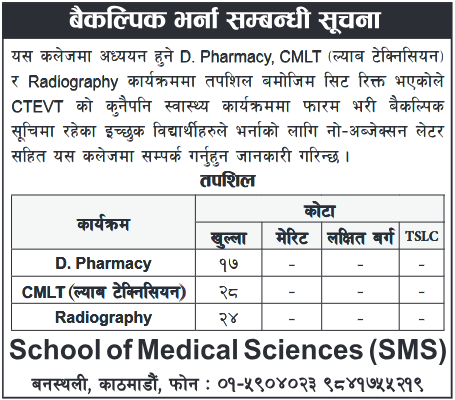
Interested students who have filled out forms for any CTEVT health program and are on the alternative list that seats are vacant, for the Diploma in Pharmacy, CMLT (Lab Technician), and Radiography programs at this college, can contact the college with a no-objection letter for admission.
Seat Details:
| Program | Quota: Open |
| D. Pharmacy | 17 |
| CMLT (Lab Technician) | 28 |
| Radiography | 24 |
View the official notice here:
School of Medical Sciences (SMS), Kathmandu, affiliated with CTEVT, has been providing quality health education since 2004. Starting with a Diploma in Pharmacy, SMS later introduced CMLT and TSLC Lab Assistant programs, now upgraded to Radiography.
Admission is now open for the following 3-year CTEVT academic programs for the academic year 2082/83:
- Certificate in Medical Laboratory Technology (CMLT)
- Certificate in Diagnostic Radiography
- Diploma in Pharmacy
Fee: 3 lakh for CMLT and Radiography
Features of the College
The School of Medical Sciences (SMS) employs modern teaching methodologies such as PowerPoint presentations, animations, and virtual labs to ensure high-quality and engaging learning experiences. The college regularly organizes seminars, workshops, and training sessions designed to develop globally competent health professionals.
To enhance practical skills, students actively participate in field visits to specialized hospital pharmacies, diagnostic laboratories, pharmaceutical industries, retail pharmacies, and reference labs across both urban and rural settings. These hands-on experiences are conducted under the close guidance of highly qualified faculty members and experienced technical staff, ensuring that students gain industry-relevant knowledge.
SMS features spacious, fully equipped laboratories furnished with the latest tools and materials, managed by a dedicated team of expert instructors and lab technicians. In addition, the college offers access to a comprehensive library stocked with a wide selection of textbooks, reference materials, journals, magazines, and daily newspapers in both Nepali and English to support academic excellence.
Furthermore, the institution enhances professional expertise through curriculum-based field training, industry and hospital exposure, bench research projects, and visits to primary healthcare centers and drug regulatory authorities, ensuring students stay updated with current trends and practices in the healthcare and pharmaceutical sectors.
ADMISSIONS OPENED BY


Related Admissions