Gaurav Ojha is a writer, researcher, and educator at different educational institutions.

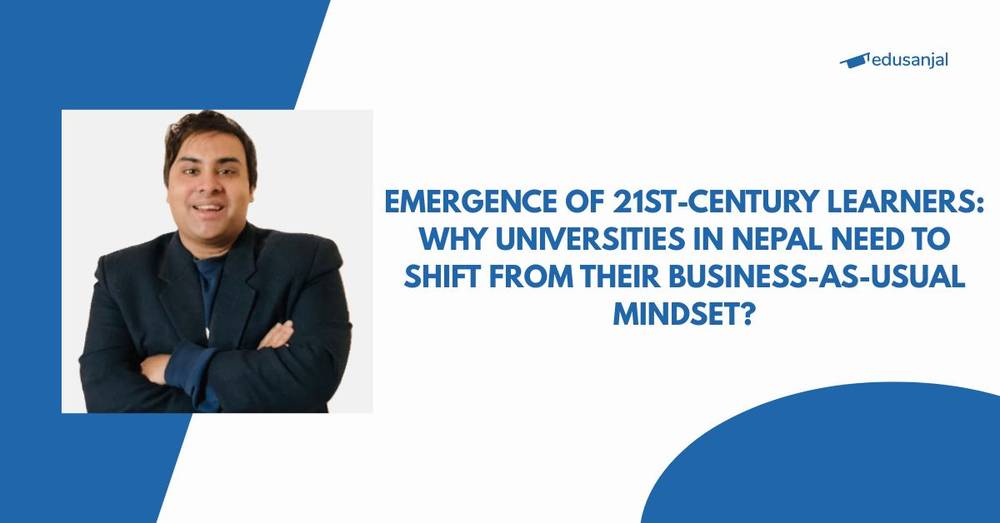
Emergence of 21st-Century Learners: Why universities in Nepal need to shift from their business-as-usual mindset?


In the digital age of global influence, aspirations and expectations of students from the higher education system in Nepal have dramatically changed from the previous generation. However, universities in Nepal, specifically during the first two decades of the 21st century, kept on dragging themselves with the assumptions and pretexts of the 20th-century higher education model that prioritized teacher-centered approach, inflexible evaluation methods, class-room based teaching and learning activities and expected academic accomplishments from the students based on the prescribed course content. This business-as-usual mindset didn’t align well with shifting aspirations of 21st-century learners, hence the increasing trend of student decline, disassociation, and dropout started to manifest in our universities and in their affiliated colleges.
Emergence of 21st-Century Learners
The 21st century has brought about significant changes in the scope, significance, and purpose of higher education. One of the most important shifts in higher education is the move towards skills rather than content knowledge. The World Economic Forum has identified a critical need for students to graduate with critical thinking, self-leadership, problem-solving, creativity, communication, teamwork, digital, and adaptability skills because the professional and workplace characteristics of the 21st century demand applicable skills more than just the ability to recall information.
Different from students of previous generations, the 21st-century learners look for a different set of aspirations, balances, and expectations from Nepalese higher education. These learners are independent, outcome-focused, career-oriented, market-savvy, tech-friendly, and economically concerned. Rather than rigid lecture-based formats and course content teaching, they want higher education with flexibility, professionalism, that balances between learning and doing, skill development, and infrastructure/facilities with international standards.
Similarly, 21st-century learners are digital natives pretty much unfamiliar with life without internet, cell phones, and computers. Hence, they prefer technologically-enhanced learning environments, which includes blended learning models, utmost use of research and educational software and a course content design that assimilates digital platforms into its pedagogical practices.
Moreover, in this age of global awareness, students in Nepal have become aware of alternative pathways, emerging trends and various modalities of courses for university level education available in the international market. There is also a growing preference among 21st-century learners for flexible schedules, dual degrees, and short-term practical courses that provide industry-ready expertise, as all career pathways do not require a full degree.
Graduate studies can’t remain as an extension of high school education
As the quality of high school-level education improved with Plus-Two and A-Level colleges in terms of technology, extracurricular activities, college events, industrial tours, classroom presentations, and project-based learning, many high school graduates started to perceive university education in Nepal as just a continuation of their school-level experience. Besides, when high school graduates were looking for something different from their high school education, our university system continued on with their existing protocols of lecture hours, mandatory classroom attendance, a teacher-centric approach, fixed course requirements, loads of theories and concepts, and a grading system based on written exams. Likewise, apart from a few exceptions, most of our institutions that run university programs are still obsessed with grades, class toppers, and dean's listers. Here, it is important to realize that graduate studies can’t simply only focus on acquiring a degree; rather, they need to establish expertise, enhance career prospects, improve professional skills and open up applied research opportunities for their graduates.
The Need for a New Mindset
The 21st-century learners are defined by their concern for acquiring a set of skills, and these skills are categorized as learning skills (the four C's: critical thinking, creativity, collaboration, and communication), literacy skills (IMT: information, media, and technology literacy), and life skills (FLIPS: flexibility, leadership, initiative, productivity, and social skills). However, universities in Nepal with their infrastructure, facilities, faculties, course designs, and education practices, have largely failed to resonate with and convince a significant portion of students that they are relevant, reliable, and effective platforms for interactive innovative and practical based higher education experiences necessary to develop these skills.
In order to convince students that what they are learning has broader socio-economic implications, faculty members in our universities and higher education system must change themselves from being merely information distributors to learning facilitators, subject matter experts, applied researchers, social media influencers, and industry partners. Likewise, universities in Nepal also need to apply effective digital marketing strategies, collaborate with online influencers, virtual platforms and create engaging social media content that appeals to digital natives. Simply talking about international standards is not enough; investments in high-tech infrastructures are equally necessary. Universities also need organize school outreach programs to connect high school student with Nepalese university system.
Moreover, our universities need to embrace a bit more agility and out-of-the-box thinking to swiftly adopt to new changes in higher education happening around the world and offer a variety of interactive platforms, business simulations, industrial exposure and multidisciplinary collaborations for students to develop their professional skills. More importantly, universities in Nepal need to realize that their “business as usual” mentality is no longer viable to attract, retain, and remain relevant to students in the twenty-first century.




Related Blogs