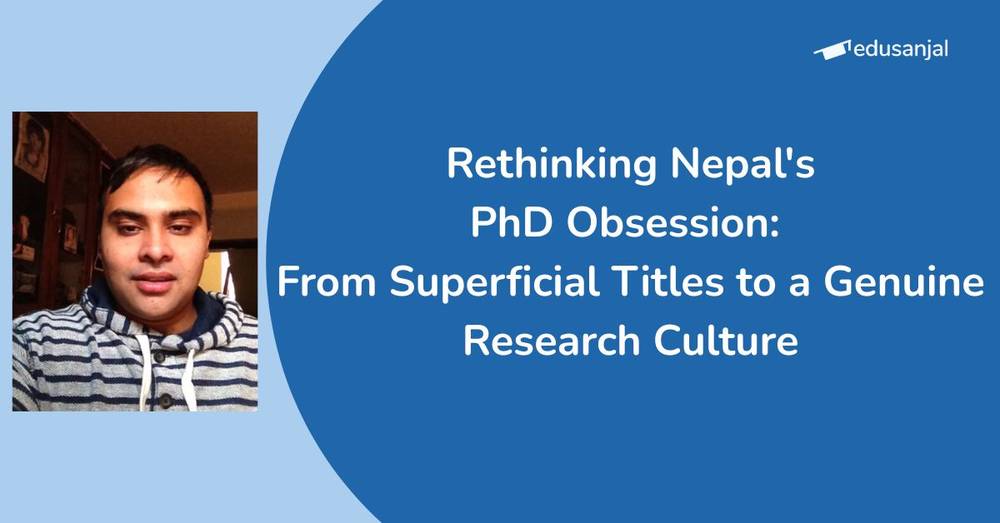
Gaurav Ojha is a writer, researcher, and educator at different educational institutions.

Rethinking Nepal's PhD Obsession: From Superficial Titles to a Genuine Research Culture


In Nepal, the true purpose of a PhD - advancing knowledge and solving complex problems- has been overshadowed by an obsession with adding "Dr." to one's name or "PhD" after it. This fixation has fueled a black market for academic shortcuts. Hence, as indicated by the recent report, in a nation where titles often carry more weight than substance, people are indeed purchasing PhDs from degree mills, unaccredited academic institutions, and foreign universities blacklisted by relevant authorities.
In addition, this ridiculous obsession with PhD degrees in Nepal has also encouraged and sustained the malpractice of hiring ghost/gift researchers to complete dissertations and publish research papers. Besides, within the context of South Asian countries, it is a reality that people don't hesitate to refer to themselves with the title "Dr." to indicate a position of authority, even if they do not hold a proper PhD qualification, simply based on conferred honorary doctorates.
False consciousness associated with a PhD degree
The term ‘false consciousness’ in Marxist theory refers to the ways that institutional, ideological, and material processes deceive members of the proletariat and other class actors in capitalist societies by hiding the exploitation and inequality that are an inherent part of class relations. In a similar vein, the misconception around the PhD obsession in Nepal reflects the belief that the key to success in both the social and professional domains is in earning the title. After all, a PhD degree serves as a badge of honor in Nepalese society, where individuals are misled into believing that the worth of a PhD is found in the credentials themselves, such as the “Dr.” title or “PhD” initials, without any genuine scholarship or proof of an original study.
With a PhD degree, even a person with a social science background can become an expert in genetics, medicine, and virology in Nepal. And, there is also a tendency to acquire a PhD degree for political or bureaucratic legitimacy among politicians, policy advisors, and bureaucrats in Nepal to showcase themselves as subject matter “experts” in public speeches, negotiations, discussions, and media appearances. Ironically, most often just the title is enough; for promotions within the university system, social recognition, or for political appointments, nobody inquires about the area of specialization, university accreditation, or methodological orientation associated with one’s PhD degree.
Similarly, some departments within the university system in Nepal have an unusually high number of doctoral graduates compared to others. There is also a growing tendency among individuals with postgraduate and MPhil studies in engineering, natural sciences, medical sciences, management studies, legal studies, economics, and psychology to obtain a PhD in their specialized subject area from humanities, social sciences, and education departments in a so-called interdisciplinary hotchpotch.
But again, “What would be the reliability, validity, acceptability, and applicability of knowledge produced in these departments, where a limited number of professors serve as experts across various knowledge domains, without rigorously adhering to theoretical, conceptual, and methodological consistencies essential for knowledge generation within specialized fields?” Additionally, our university system remains heavily entrenched in disciplinary silos with very few cross-departmental research collaborations. Seriously, would you trust a doctor who claims to be an orthopedic surgeon, dentist, gastroenterologist, heart specialist, and psychiatrist?
Enlightenment ideals of PhD scholarship
Here, Universities in Nepal need to understand that the doctorate of philosophy (PhD), which originated in Germany in the 17th century, was never meant to be merely another academic title. The founder of the University of Berlin, Wilhelm von Humboldt, saw this degree as the highest honor in academia, grounded in the Enlightenment principles of reason, freedom, logic, and scientific research. His model for doctorate study program was created to integrate current research with the expansion and enhancement of existing knowledge, making it an integral component of the teaching and learning process. The basic purpose of PhD studies was to encourage students to discover something new or think outside the box about their knowledge area.
As history indicates, philosopher of science and mathematical logic Ludwig Wittgenstein earned his Cambridge PhD through his groundbreaking work Tractatus Logico-Philosophicus, even without a bachelor’s degree. Hence, the essence of a PhD lies not in formalities, protocols, and hierarchies but in the transformative contribution to human understanding. However, the PhD degree, envisioned as the highest pursuit of knowledge and a symbol of intellectual integrity, loses its intended purpose when it shifts away from its enlightenment ideals grounded in originality, rigor, and ethical scholarship. Besides, when a PhD degree becomes a mere credential to secure professional, academic, political, and social status, it risks falling into corrupt practices such as the purchase of degrees, reliance on ghost researchers, and the recycling of published research work and established models.
Weak Research Culture in Nepal
At the heart of Nepal’s PhD crisis lies a fragile research ecosystem. Genuine doctoral training depends on mentorship, infrastructure, funding, research-career development support, academia-industry collaborations, and a vibrant community of inquiry. However, these conditions are largely absent in our universities. Hence, doctoral programs in Nepali universities have failed to link research to real-world applications, and PhD graduates gain the title even without engagement with industries, technologies, business, or communities, where their research outcomes could generate a tangible impact.
For example, a person who has completed a PhD in the area of online education in Nepal acquires academic position, becomes a professor of social sciences, an education expert, a commentator on contemporary socio-political issues, and a thesis supervisor in international corporations, despite having no interaction with software companies, digital platforms, or technical innovations that are directly tied to online education. Here, the main question is what is the value of becoming a PhD graduate without domain-specific expertise?
In contrast, if we look at the career of Genevieve Bell, Vice-Chancellor of the Australian National University, as a cultural anthropologist after her PhD, she was selected by Intel Corporation to build social-science research competency in the advanced research and development labs. Similarly, her anthropological ethnographic research has been assimilated by the tech giant Intel Corporation for developing computer applications and information technologies that are better aligned and assimilated with socio-cultural human experiences. More importantly, her example highlights what Nepal’s PhD research culture lacks: the ability to translate inquiry into practice. A PhD has become a mere tool for acquiring academic positions without any contribution to the socio-economic, political, ethical, and cultural transformation of the nation.
Moreover, for the higher education system in Nepal to move forward, universities, policymakers, and the public must shift their focus from producing more "doctors" to cultivating critical/creative thinkers, innovators, inventors, tech experts, industry collaborators, and problem-solvers. After all, Nepalese universities, to attract both local and international students, need notable faculties, students, and alumni who are well-known as scientists, theorists, technology experts, paradigm shifters, economists, innovators, inventors, artists, and disruptive thinkers. More importantly, beyond the volume of research publications, indices, and acquiring a PhD degree, the university system in Nepal must realize that the future of higher education lies in cultivating a generation of scholars who are prepared to acknowledge research as a transformative instrument for the socio-economic, political, artistic, technological, industrial, ethical, and cultural progress of Nepal.




Related Blogs